History
Albuquerque has been a river crossing, a Spanish villa, an army depot, a railroad town, a stop on Route 66 and the home of a laboratory and a balloon festival. This page tells that story in short, with a link to the source for every claim.

A short history of Albuquerque
Albuquerque has been a river crossing, a Spanish villa, an army depot, a railroad town, a stop on Route 66 and the home of a laboratory and a balloon festival. This page tells that story in short, with a link to the source for every claim. For the full text of the old travellers’ books, see the reading list.
The first people
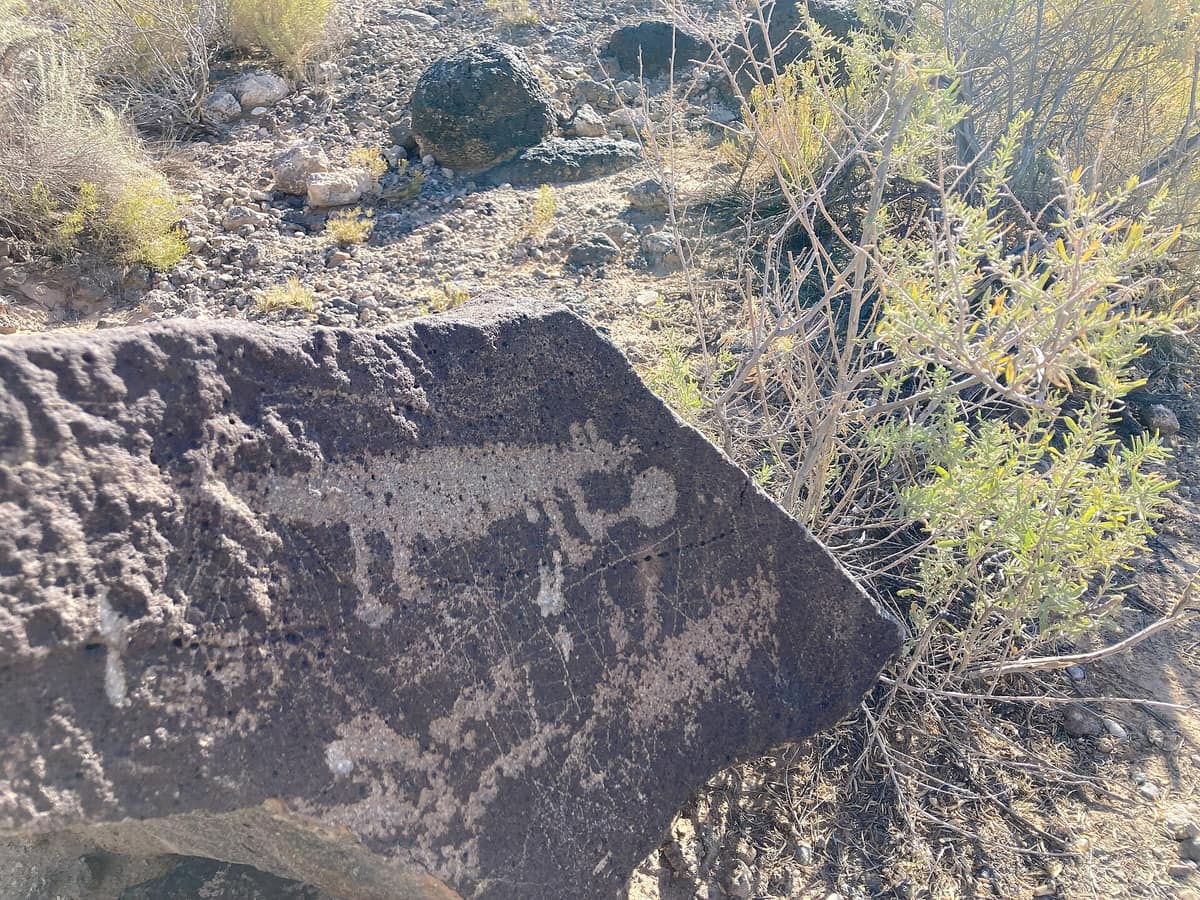
The Tiwa and Keres peoples lived along the Rio Grande for centuries before Europeans arrived. By the 1500s there were around 20 Tiwa pueblos along a 60-mile stretch of the river, and two Tiwa pueblos still lie on the edge of today’s city: Sandia Pueblo, founded in the 14th century [8], and the Pueblo of Isleta, documented in writing since the early 17th century [9]. Kuaua, the pueblo whose ruins lie at Coronado Historic Site north of the city, was settled about 1325 [7]. The thousands of petroglyphs on the West Mesa, now Petroglyph National Monument, were carved mostly between AD 1300 and the end of the 17th century [15].
In the winter of 1540-41 the expedition of Francisco Vázquez de Coronado fought the Tiguex War against the pueblos along the river near today’s Bernalillo, the first named war between Europeans and Native Americans in what is now the United States [6].
A villa on the royal road
La Villa de Alburquerque was founded in 1706 by the governor Francisco Cuervo y Valdés and named for the 10th Duke of Alburquerque, then Viceroy of New Spain. It was an outpost on El Camino Real, which linked Mexico City to the northernmost territories of New Spain [1]. The road itself ran about 1,590 miles, from Mexico City to San Juan Pueblo, and was used from 1598 to 1882 [5].
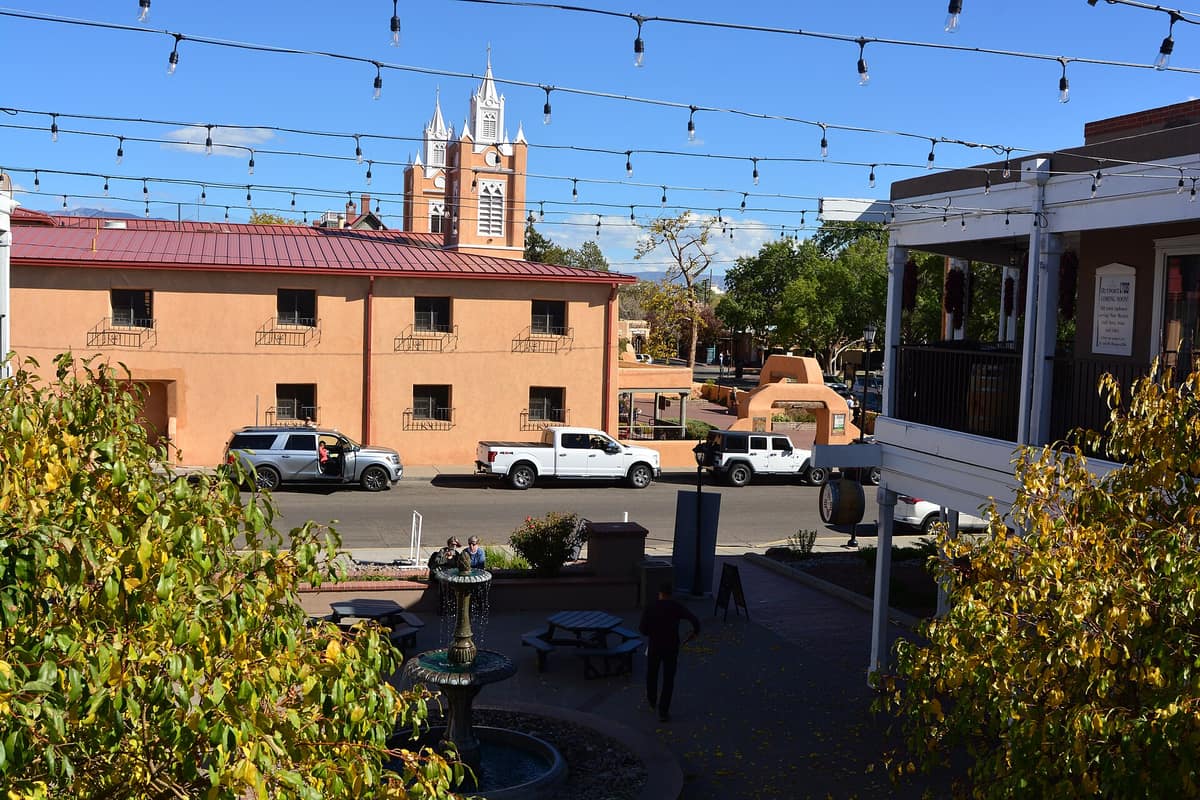
The villa was laid out in the Spanish way, around a plaza with government buildings, houses and a church [1]. The church on the north side of the plaza collapsed in the winter of 1792-93, and its replacement, San Felipe de Neri, was begun in 1793 and is still a working parish church [3]. Old Town’s plaza area was sometimes called La Placita [1]. To the south, the river crossing at Barelas, formally established in 1662, is considered the oldest neighbourhood in the city [4].
Mexico, the army and the Civil War
After Mexico won independence in 1821 it kept a military presence here, and after 1846 the United States set up a garrison and a quartermaster depot, the Post of Albuquerque, which operated until 1867 [1]. W. W. H. Davis, the United States Attorney, rode the court circuit here in the 1850s and described a plaza of two or three acres, mud-brick houses and an army depot that put money into the town [16]. In 1859 the journalist Albert D. Richardson passed through and called it one of the richest and pleasantest towns on the road, with about 3,000 people [17].
In February 1862 Confederate troops under General Henry Hopkins Sibley occupied the town, and on April 8 a day-long, long-range fight, the Battle of Albuquerque, ended with few casualties [1].
The railroad’s New Town
The Atchison, Topeka and Santa Fe Railway arrived in 1880 and put its depot about two miles east of the plaza, which started a rival New Town. New Albuquerque was incorporated as a town in 1885 and as a city in 1891 [1]. Old Town fell quiet, but its fortunes turned in the 1940s: the Old Albuquerque Historical Society was founded in 1946 and the city annexed Old Town in 1949 [2]. In 1902 the Alvarado Hotel opened beside the depot; it was torn down in 1970, and in 2002 the Alvarado Transportation Center was built on the site in a style that echoes it [1]. Barelas grew around the railway shops until they closed in 1970 [4].
Route 66 and Central Avenue
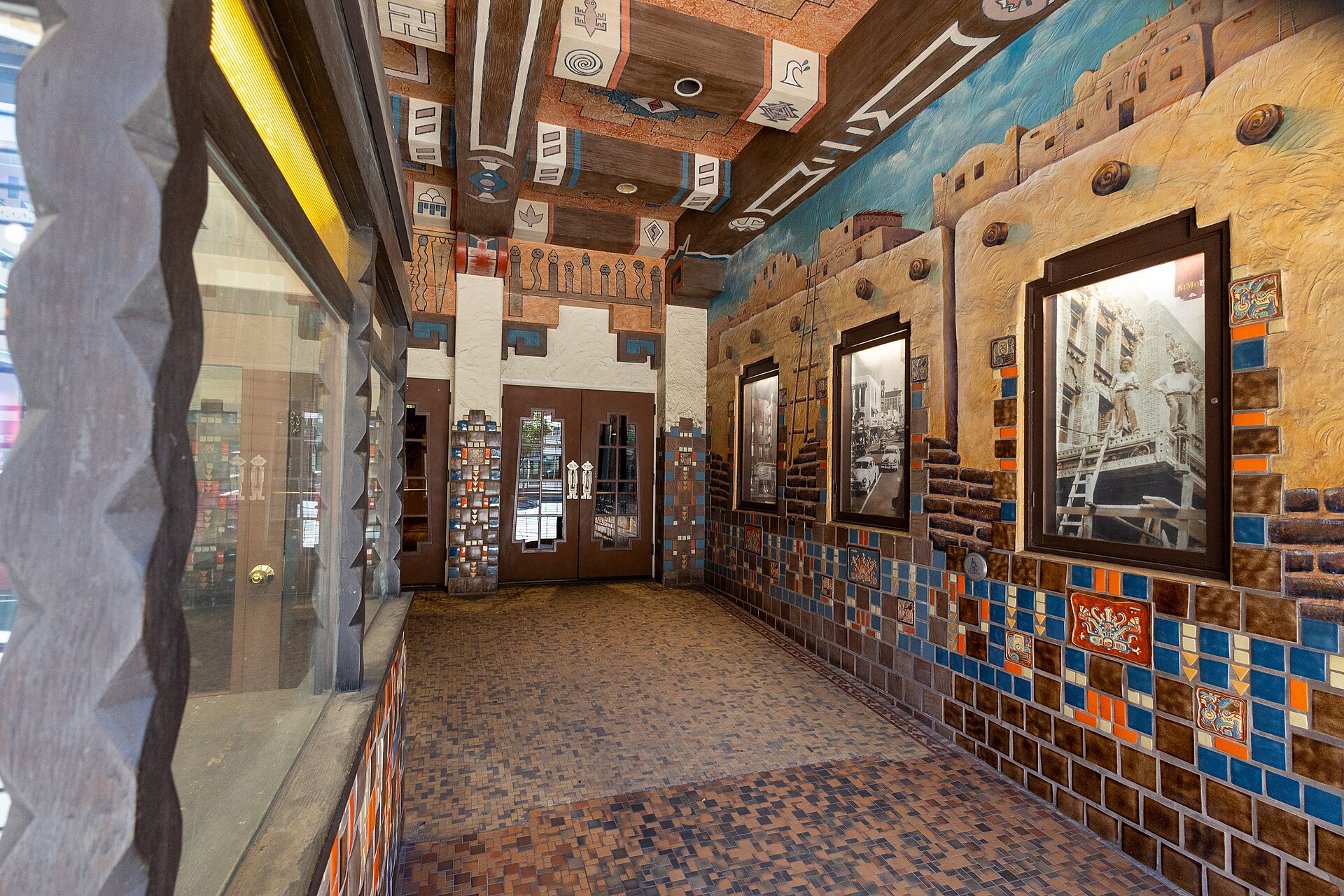
The first travellers on Route 66 reached Albuquerque in 1926, on Fourth Street. In 1937 the highway was moved onto Central Avenue, a more direct east-west line, and by 1955 Central had 98 motels [1] [10]. Developer D.K.B. Sellers had named Nob Hill after a San Francisco neighbourhood in 1916, and its shops and motels grew along Central in the 1930s [11]. The KiMo Theatre opened in 1927, and after a fire and years of decline it was saved by the city and restored [12]. Interstate 40 pulled traffic away in the 1960s, and Central came back from the 1980s as an arts and entertainment district [10].
The Atomic Age
Kirtland Air Force Base was established in 1939 and Sandia National Laboratories in 1949, which made Albuquerque a key place in the Atomic Age [1].
Balloons and gatherings
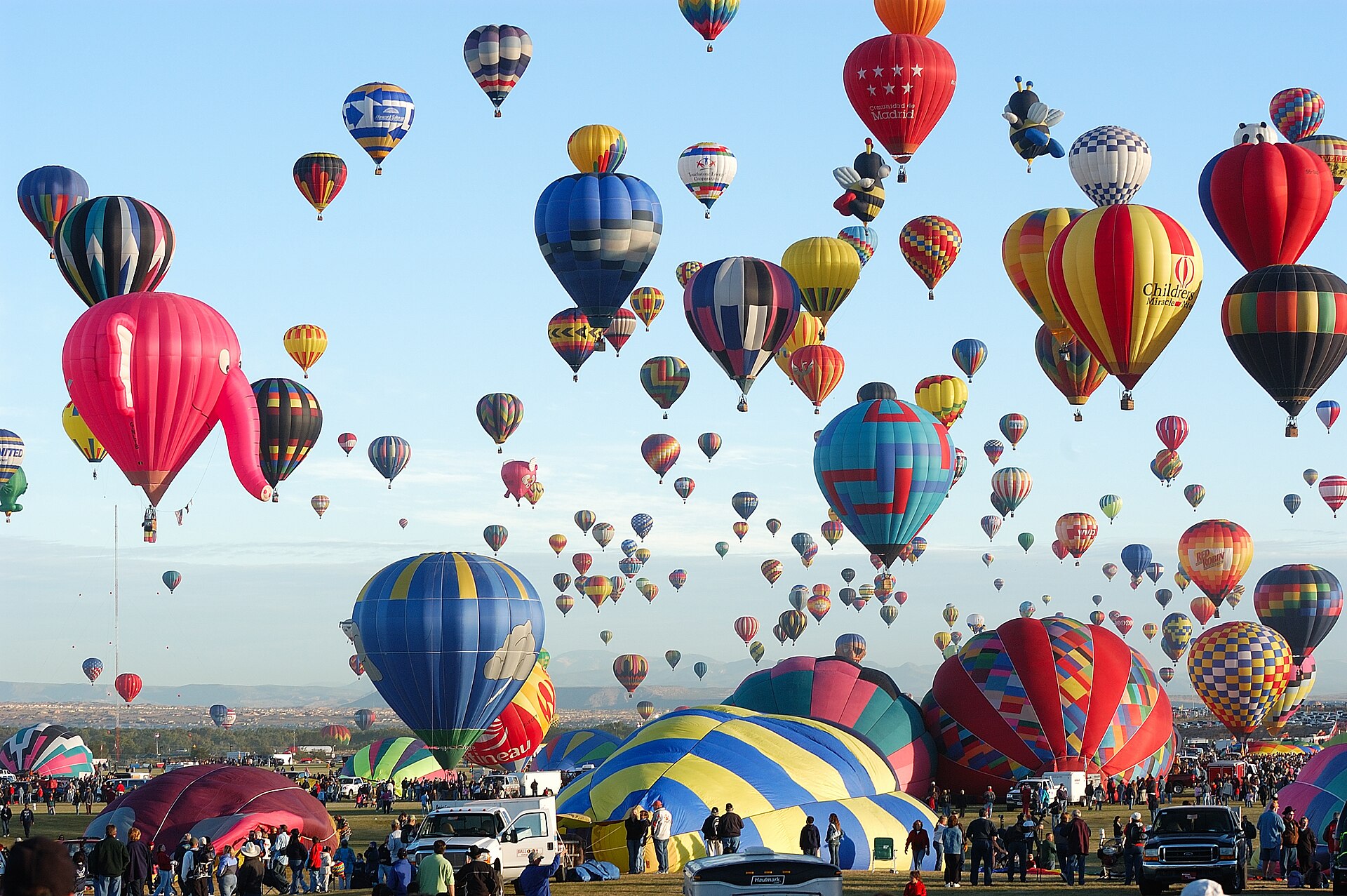
The Albuquerque International Balloon Fiesta began on April 8, 1972 with 13 balloons in a shopping-centre parking lot, for radio station KOB’s 50th birthday. It moved to early October in 1975, and today it has more than 500 balloons and is the largest balloon festival in the world [13]. The next Fiesta, the 55th, is scheduled for October 2-10, 2027 [13]. The New Mexico State Fair was first held in October 1881 and moved to mid-September in 1960 [18]. The Gathering of Nations, the largest pow-wow in North America, was held at the University of New Mexico until 2016 and at Expo New Mexico from 2017; its organisers announced that the 2026 gathering would be the last [14].
Today
Albuquerque had 564,559 residents at the 2020 census and is the most populous city in New Mexico [1]. The Sunport’s Pueblo Revival terminal handles about 5.5 million passengers a year [19]. In Barelas, the National Hispanic Cultural Center, opened in 2000, brought visitors and investment back to the neighbourhood [4]. The city is also a film location: Breaking Bad was set and filmed here [1]. Old Town, Nob Hill and Barelas are all still places where you can see the layers.
Key dates
01
1300s
Sandia Pueblo is founded
Sandia Pueblo, a Tiwa pueblo on the city’s northern edge, dates from the 14th century. Source ↗
02
1540
Coronado and the Tiguex War
Coronado’s expedition fights the Tiwa pueblos along the Rio Grande in the winter of 1540-41. Source ↗
03
1706
La Villa de Alburquerque
Governor Cuervo y Valdés founds the villa and names it for the Duke of Alburquerque. Source ↗
04
1793
San Felipe de Neri Church
The present adobe church is begun on the north side of the plaza. Source ↗
05
1862
The Battle of Albuquerque
Retreating Confederate troops fight Union soldiers in a day-long, long-range battle with few casualties. Source ↗
06
1880
The railroad and New Town
The Santa Fe Railway builds its depot two miles east of the plaza and a new town grows around it. Source ↗
07
1927
The KiMo Theatre opens
A Pueblo Deco picture palace opens on Central Avenue on September 19. Source ↗
08
1937
Route 66 moves to Central
The highway is realigned from Fourth Street onto Central Avenue, and motels multiply. Source ↗
09
1949
Sandia National Laboratories
Created ten years after Kirtland Air Force Base, it makes Albuquerque a center of the Atomic Age. Source ↗
10
1972
The first Balloon Fiesta
Thirteen balloons lift off from a shopping-center parking lot on April 8. Source ↗
11
2000
The National Hispanic Cultural Center
The 20-acre campus opens in Barelas. Source ↗
12
2026
The last Gathering of Nations
The largest pow-wow in North America holds what its organizers announced as its final gathering. Source ↗
Sources
1. Albuquerque, New Mexico — Wikipedia
2. Old Town Albuquerque — Wikipedia
3. San Felipe de Neri Church — Wikipedia
5. Camino Real de Tierra Adentro — Wikipedia
7. Coronado Historic Site — Wikipedia
9. Pueblo of Isleta — Wikipedia
10. Central Avenue (Albuquerque) — Wikipedia
11. Nob Hill, Albuquerque, New Mexico — Wikipedia
13. Albuquerque International Balloon Fiesta — Wikipedia
14. Gathering of Nations — Wikipedia
15. Petroglyph National Monument — Wikipedia
16. El Gringo; or, New Mexico and her people (1857) — Internet Archive
17. Beyond the Mississippi (1867) — Internet Archive
Further reading
El Gringo; or, New Mexico and her people, W. W. H. Davis (1857) — public domain, free to read online
Beyond the Mississippi: from the great river to the great ocean, Albert D. Richardson (1867)
The Land of Poco Tiempo, Charles F. Lummis (1893)
Albuquerque: A Narrative History, Marc Simmons (1982) — borrow it from the Internet Archive
The Duke City: The Story of Albuquerque, New Mexico, 1706–1956, Francis Stanley (1963) — borrow it from the Internet Archive
Albuquerque Remembered, Howard Bryan (2006) — borrow it from the Internet Archive